How to Choose a Baby’s First Autumn Cap by Size and Routine
How to Choose Your Baby’s First Autumn Cap
Why choose the first autumn cap now?
The first separate autumn cap makes the most sense once the weather has cooled enough that you no longer want to go out without one, while you are not yet dealing with winter gear. For a baby, the main thing is that the cap fits comfortably and without unnecessary thought during the usual daily routine: a short trip outside, time in the stroller, moving to the car, or a quick errand. That is why it is sensible to narrow the choice down to one specific type and the right size instead of getting lost in impressions created by the name, colour, or age label.
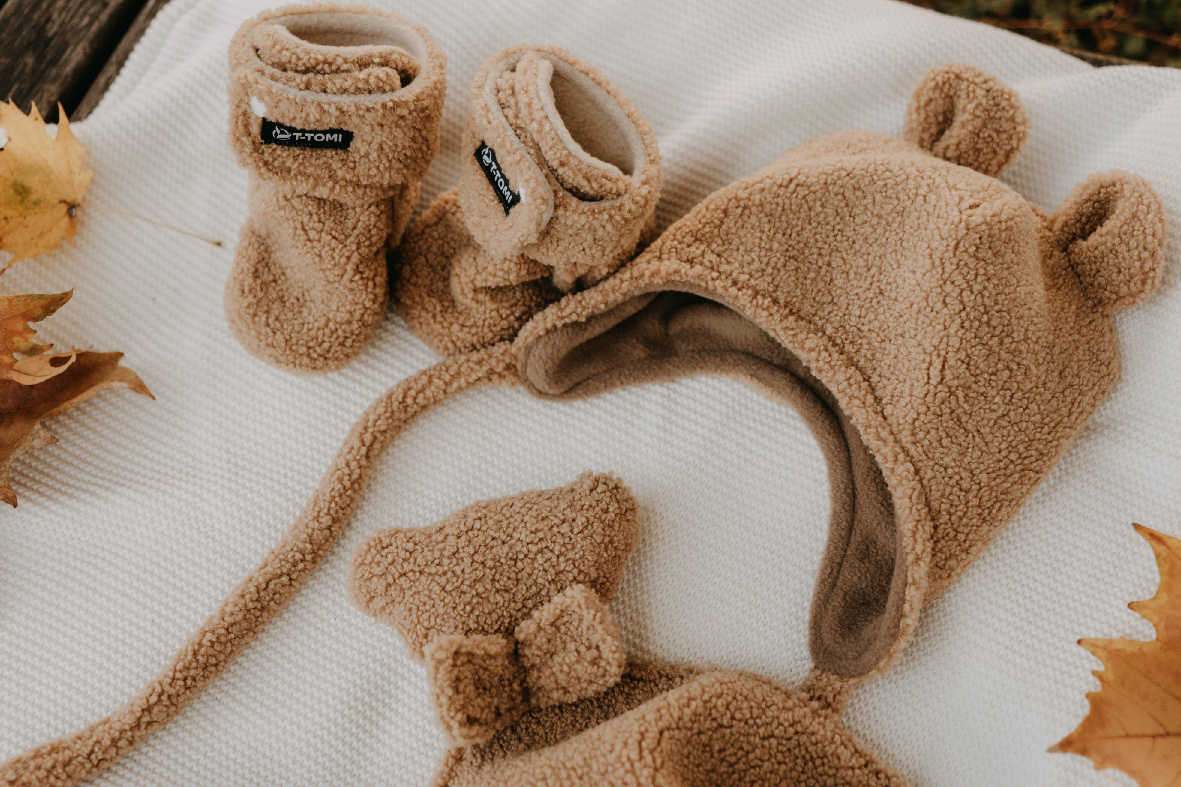
With the “T-TOMI Cap TEDDY” model, it is practical for parents that it is available in four sizes. This makes the decision easier: you do not need to consider dozens of cuts, but can focus on what matters — head circumference and how the cap will fit into your usual routine of walks during the coming cooler weeks. For a quick answer, start by measuring your baby’s head and only then look at the age stated for the size.
What matters most: head circumference, not a visual guess
The most reliable guide is head circumference. For example, with “T-TOMI Cap TEDDY”, size 0–3 months is stated for a head circumference of 33–36 cm, while size 9–12 months is for 44–48 cm. This is more important for choosing than the impression that a child is smaller or bigger for their age. Babies do not all grow at the same pace, and the age range alone is not enough. If you choose only by months, it is easy to pick a cap that fits less well than necessary.
You can measure simply with a tailor’s tape measure around the widest part of the head. If you do not have one, use a piece of string and then place it against a ruler. Measure calmly, without adding a large extra margin. For a first autumn cap for everyday outdoor wear, a precise choice is more practical than buying “for later”.
How to read age labels without unnecessary guessing
Treat the age label as a useful guide, not the final answer. When you see size 0–3 months, it does not automatically mean it will fit every child in that period. Likewise, size 9–12 months is not necessarily correct simply because the child’s age falls within that range. What matters is whether the measured circumference matches the stated centimetres. This helps you avoid returns and daily adjustment of the cap during walks.
The practical approach is simple: first write down the measured circumference, then look at the stated range for the size, and only then take age into account. When the child is between two sizes, consider how often and at what pace you will use the cap in the coming weeks. For regular short walks, a size that feels secure from the beginning is usually more comfortable than one chosen with too much extra room. With a first separate cap, parents appreciate simplicity most.
What to expect from an autumn cap in practice
For this model, the cap is stated to have a fleece lining and a TEDDY outer material. For parents, the important point is mainly that this is not a summer item, but an option for cooler weather. At the same time, it is good to keep expectations realistic and not expect the cap to do more than it should: it should be a sensible part of everyday autumn clothing during regular walks. There is no need to make it a universal solution for every situation from autumn through winter.
It is also useful to think about regular textile care in general. Before first use and later on, follow the information on the product label and keep the cap dry and clean in the same place so you do not have to search for it when leaving.
Common mistakes and a quick decision process
The most common mistake is buying by age without measuring the head. The second is buying a first autumn cap with unnecessarily large extra room just so it lasts longer. During ordinary short walks, parents then deal with adjustments and doubts about whether the cap fits properly instead of enjoying a simple routine. The third mistake is giving too much importance to the fact that one size is described in the same way as another. A similar description only means it is the same product in a different size.
You can decide in just a few minutes. Step one: measure head circumference. Step two: compare the number with the stated size range, for example 33–36 cm for the 0–3 months variant or 44–48 cm for the 9–12 months variant. Step three: consider whether you need the cap mainly for regular short walks in the coming weeks. Step four: choose the size that matches the current situation, not the idea of what may happen in several months. This leads to a practical, calm choice without unnecessary hesitation.
Frequently asked questions
Should I choose by age or by centimetres?
Always give priority to head circumference in centimetres. Age is useful only as guidance. When the measured value matches the stated size range, the choice is usually more accurate and more practical for everyday autumn wear than estimating by months.
What if my baby is exactly between two sizes?
Consider how you will use the cap in the coming weeks. For ordinary short walks, the size that fits securely now is often more suitable than a variant chosen mainly with room for future growth.
Is it important to consider the material and lining?
Yes, but only according to what is explicitly stated for the product. “T-TOMI Cap TEDDY” is stated to be made of 100% polyester, with TEDDY material and fleece inside. For the decision, however, the correct size and usual pattern of use remain most important.